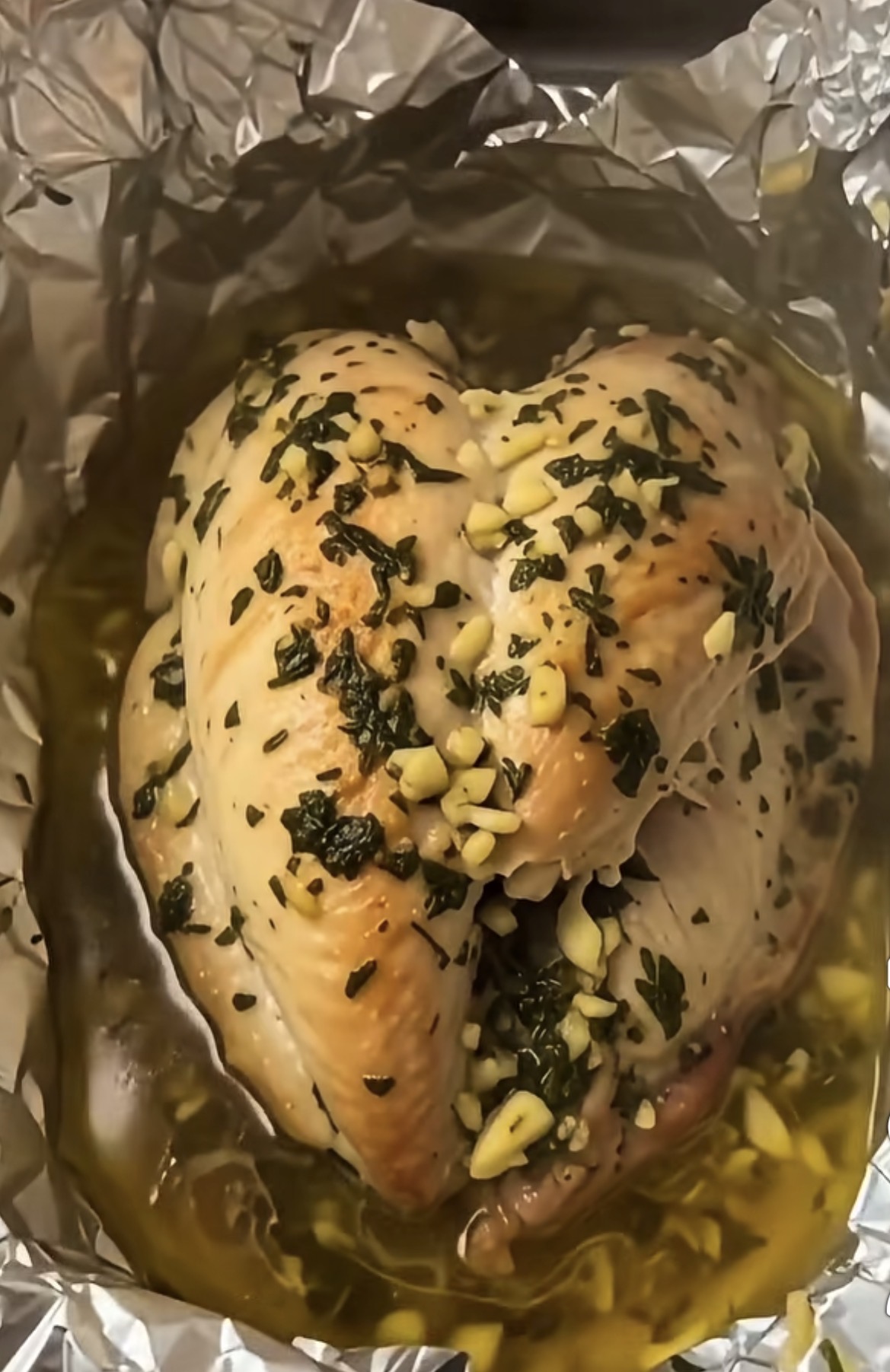
The Ultimate Foil-Wrapped Herb Butter Turkey Breast
Looking for a delicious way to prepare a tender, juicy turkey breast without making an entire turkey? This Foil-Wrapped Herb Butter Turkey Breast is a wonderful choice for a holiday dinner, Sunday family meal, or any occasion when you want something special without complicated preparation.
A simple mixture of softened butter, garlic, and fragrant herbs creates a rich coating that adds flavour to every bite. Wrapping the turkey breast in aluminium foil helps retain moisture during roasting, while the buttery juices collect around the meat and create a delicious base for serving.
The result is beautifully seasoned turkey with a tender centre and plenty of savoury flavour. Slice it for a festive dinner, serve it alongside your favourite vegetables, or use the leftovers for sandwiches and easy weekday meals.
Recipe Overview
This oven-roasted turkey breast is coated with a savoury herb butter mixture and wrapped in foil to help keep the meat moist while it cooks.
- Preparation Time: 15 minutes
- Cooking Time: Approximately 1 hour 30 minutes to 2 hours, depending on the size and shape of the turkey breast
- Total Time: Approximately 1 hour 45 minutes to 2 hours 15 minutes, plus resting time
- Servings: 6–8, depending on the size of the turkey breast
- Course: Main Course
- Cuisine: American-inspired
- Cooking Method: Oven roasting
- Difficulty: Easy
Why You’ll Love This Herb Butter Turkey Breast
1. Tender and Moist Turkey
Wrapping the turkey breast in foil helps retain moisture during roasting. The butter mixture also adds richness and flavour to the meat.
2. Simple Herb Butter Flavour
Garlic, rosemary, thyme, and parsley create a classic savoury combination that complements turkey beautifully.
3. Perfect for Smaller Gatherings
You can enjoy a traditional turkey dinner without roasting a whole bird. A turkey breast is a practical option for smaller holiday gatherings and family meals.
4. Easy Preparation
There is no complicated technique involved. Prepare the herb butter, coat the turkey, wrap it securely, and let the oven do the work.
5. Delicious Leftovers
Leftover turkey breast can be sliced for sandwiches, added to salads, or served with potatoes and vegetables for another easy meal.
Ingredients for Foil-Wrapped Herb Butter Turkey Breast
The following is a suggested ingredient list for a classic herb butter version. Because the recipe title was supplied without exact quantities or a cooking method, these amounts are a practical starting point rather than confirmed original measurements.
- 1 boneless turkey breast (approximately 3–4 pounds): The main ingredient. Choose a fully thawed turkey breast for more even cooking.
- 1/2 cup unsalted butter, softened: Creates the rich herb butter coating and helps the seasonings adhere to the turkey.
- 3 garlic cloves, minced: Adds savoury flavour and complements the fresh herbs.
- 1 tablespoon fresh rosemary, finely chopped: Provides a fragrant, earthy flavour.
- 1 tablespoon fresh thyme leaves: Adds a gentle herbal note.
- 1 tablespoon fresh parsley, chopped: Brings freshness and colour to the butter mixture.
- 1 teaspoon salt: Seasons the turkey. Adjust according to the size of the breast and whether it has already been brined or seasoned.
- 1/2 teaspoon black pepper: Adds a mild peppery flavour.
- 1/2 teaspoon paprika: Optional, for colour and a gentle savoury note.
Optional: A little lemon zest can brighten the herb butter. If the turkey breast is already salted or injected with a seasoned solution, reduce or omit the additional salt.
Ingredient Notes and Substitutions
Turkey Breast
A boneless turkey breast is convenient because it cooks relatively evenly and is easy to slice. A bone-in turkey breast can also be used, but it may need a different cooking time. Always check the thickest part of the meat with a food thermometer.
Unsalted Butter
Softened unsalted butter makes it easy to combine the herbs and garlic into a spreadable mixture. Using unsalted butter also gives you better control over the seasoning.
If you only have salted butter, reduce the added salt to avoid an overly salty result.
Fresh Garlic
Freshly minced garlic adds a strong, savoury flavour. Garlic powder can be used as an alternative, although the flavour will be slightly different.
Rosemary and Thyme
Rosemary and thyme are classic herbs for roasted turkey. Their aromatic flavours work particularly well with butter and garlic.
Dried herbs can be substituted if fresh herbs are unavailable. Use smaller quantities because dried herbs are more concentrated.
Parsley
Fresh parsley adds a mild herbal flavour and a little colour. It can be omitted or replaced with another herb if preferred.
Black Pepper and Paprika
Black pepper provides gentle warmth, while paprika adds colour and a subtle savoury flavour. Paprika is optional and can be left out without affecting the basic cooking method.
Kitchen Equipment You’ll Need
- Roasting pan: Holds the wrapped turkey breast during roasting.
- Heavy-duty aluminium foil: Helps create a secure packet around the turkey.
- Small mixing bowl: For preparing the herb butter.
- Measuring spoons: For measuring the herbs and seasonings.
- Kitchen brush or spatula: For spreading the herb butter over the turkey.
- Instant-read food thermometer: Essential for checking that the turkey reaches a safe internal temperature.
- Sharp carving knife: For slicing the rested turkey breast.
How to Make Foil-Wrapped Herb Butter Turkey Breast
Step 1: Prepare the Turkey
Thaw the turkey breast completely in the refrigerator if it is frozen. Remove the packaging and any included gravy packet or seasoning sachet.
Pat the turkey dry with paper towels. Removing excess surface moisture helps the herb butter spread more easily.
Step 2: Prepare the Herb Butter
Place the softened butter in a small mixing bowl. Add the minced garlic, chopped rosemary, thyme, parsley, salt, black pepper, and optional paprika.
Mix until all the ingredients are evenly distributed and the butter becomes a fragrant herb mixture.
Step 3: Coat the Turkey Breast
Place the turkey breast on a clean surface or in the roasting pan. Spread the herb butter over the top and sides of the turkey.
If the skin is still attached, gently loosen it with clean fingers and spread some butter underneath without tearing the skin. This helps season the meat beneath the surface.
Step 4: Wrap the Turkey in Foil
Place the turkey breast in the centre of a large sheet of heavy-duty aluminium foil. Fold the foil around the turkey and seal the edges securely to create a covered packet.
Leave a little space above the meat so the foil does not press tightly against the surface. If needed, use a second sheet of foil to make a secure seal.
Step 5: Prepare for Roasting
Preheat the oven to 350°F (175°C). Place the foil-wrapped turkey breast in a roasting pan with the sealed edges facing upwards.
Keep the packet supported by the roasting pan so that any butter and cooking juices remain contained.
Step 6: Roast Until Safely Cooked
Roast until the thickest part of the turkey breast reaches an internal temperature of 165°F (74°C). Cooking time depends on the weight, shape, starting temperature, and whether the turkey is boneless or bone-in.
Begin checking the temperature before the estimated cooking time ends. Insert the thermometer into the thickest part of the meat, avoiding contact with the pan or any bone.
Step 7: Optional Browning
If you want a more golden surface, carefully open the foil during the final part of cooking once the turkey is close to being done. Return it to the oven briefly to brown the outside.
Keep a close eye on the turkey so the surface does not become too dark. If you open the foil, handle the hot steam carefully.
Step 8: Rest Before Slicing
Once the turkey reaches 165°F (74°C), remove it from the oven. Let it rest for approximately 10–15 minutes before slicing.
Transfer the turkey to a cutting board and slice against the grain where possible. Spoon some of the collected herb butter juices over the slices before serving.
Why Wrap Turkey Breast in Aluminium Foil?
Foil wrapping is a useful technique when roasting turkey breast because it creates a covered cooking environment that helps retain moisture.
Helps Retain Moisture
The foil packet reduces the amount of moisture that escapes during cooking. This is especially useful for lean turkey breast, which can become dry if overcooked.
Holds the Herb Butter and Juices
As the butter melts, it combines with the turkey’s natural juices and herbs. Keeping the turkey wrapped helps retain these flavours around the meat.
Reduces Surface Browning During the Main Cooking Time
Because the turkey is covered, the surface will not brown as quickly as it would when roasted uncovered. Opening the foil near the end is an optional way to add colour.
Important Foil Safety Note
Use oven-safe aluminium foil according to the manufacturer’s instructions. Do not allow foil to touch heating elements or the sides of the oven where it could cause a hazard.
Helpful Tips for the Best Herb Butter Turkey Breast
- Thaw completely: Start with fully thawed turkey so it cooks more evenly.
- Pat the surface dry: This makes the herb butter easier to spread.
- Use softened butter: Soft butter blends smoothly with garlic and herbs.
- Season underneath the skin: If the skin is attached, adding some herb butter underneath can improve flavour.
- Seal the foil carefully: A secure packet helps retain the buttery cooking juices.
- Use a roasting pan: It supports the foil packet and catches any leaks.
- Check the temperature: Use a food thermometer rather than relying only on estimated cooking time.
- Rest before slicing: Resting helps the juices settle before carving.
- Save the pan juices: Spoon the herb butter juices over the sliced turkey before serving.
Common Mistakes to Avoid
1. Roasting Turkey While Still Frozen
A frozen or partially frozen turkey breast can cook unevenly. Thaw it safely in the refrigerator before preparing the recipe.
2. Using Too Much Salt
Some turkey breasts are already brined or injected with a seasoned solution. Check the packaging before adding salt to the herb butter.
3. Wrapping the Foil Too Loosely
If the foil is not sealed properly, the butter and juices may escape into the roasting pan. Fold the edges securely and use a second layer if necessary.
4. Guessing the Cooking Time
Turkey breast sizes and shapes vary considerably. A food thermometer is the most reliable way to check doneness.
5. Overcooking the Turkey
Turkey breast is lean and can become dry if cooked beyond the recommended temperature. Remove it from the oven once the thickest part reaches 165°F (74°C).
6. Slicing Immediately
Cutting the turkey immediately after roasting can cause more juices to run onto the cutting board. Allow it to rest before slicing.
Easy Herb Butter Turkey Variations
Garlic Parmesan Herb Butter
Mix a small amount of finely grated Parmesan into the herb butter for a richer, savoury flavour. Keep the cheese quantity modest so the coating remains easy to spread.
Lemon Rosemary Turkey
Add fresh lemon zest and a little lemon juice to the butter mixture. Lemon brings a bright flavour that complements rosemary and garlic.
Honey Herb Butter
Add a small amount of honey to the herb butter for a subtle sweetness. This version pairs nicely with roasted carrots and sweet potatoes.
Smoky Paprika Turkey
Increase the paprika slightly or use smoked paprika for a deeper, more savoury flavour.
Simple Dried Herb Version
If fresh herbs are unavailable, use dried rosemary, thyme, and parsley. Start with smaller quantities because dried herbs are more concentrated than fresh herbs.
What to Serve with Herb Butter Turkey Breast
This turkey breast is versatile and pairs beautifully with classic holiday sides, roasted vegetables, and simple family favourites.
- Garlic mashed potatoes: A creamy side that works perfectly with the herb butter juices.
- Roasted carrots: Their natural sweetness complements the savoury turkey.
- Green beans: A fresh vegetable side for a balanced dinner.
- Classic stuffing: A traditional choice for a holiday-style meal.
- Roasted Brussels sprouts: Their caramelised edges add extra flavour and texture.
- Sweet potato casserole: A comforting side for Thanksgiving or Christmas dinner.
- Cranberry sauce: Adds a sweet and tart contrast to the rich herb butter.
- Dinner rolls: Perfect for soaking up the buttery juices.
For an attractive serving platter, arrange sliced turkey breast in overlapping rows, spoon the herb butter juices over the top, and garnish with fresh rosemary and thyme.
Storage and Reheating
How to Store Leftover Turkey
Allow the turkey to cool slightly, then divide it into smaller portions. Place the meat in shallow airtight containers and refrigerate within two hours of cooking.
For best quality and food safety, use refrigerated cooked turkey within 3 to 4 days.
How to Reheat in the Oven
Place sliced turkey in an oven-safe dish. Add a little broth or reserved herb butter juices to help prevent it from drying out. Cover with foil and warm in a preheated 325°F (163°C) oven until the centre reaches 165°F (74°C).
How to Reheat in the Microwave
Place individual portions in a microwave-safe dish. Add a small amount of broth or pan juices and cover loosely. Heat in short intervals, turning or rearranging the slices as needed, until steaming hot and the centre reaches 165°F (74°C).
Can You Freeze Cooked Turkey Breast?
Yes. Slice or portion the cooked turkey and place it in freezer-safe containers or bags. Add a little cooking juice to help preserve moisture. For best quality, use within 2 to 3 months.
How to Thaw Frozen Turkey
Thaw frozen cooked turkey in the refrigerator. Reheat thoroughly to 165°F (74°C) before serving. Do not thaw cooked turkey at room temperature.
Frequently Asked Questions
1. Should I use boneless or bone-in turkey breast?
Either can work. Boneless turkey breast is convenient to slice, while bone-in turkey breast may need a different cooking time. Always check the thickest part with a thermometer.
2. What temperature should I roast turkey breast at?
This suggested recipe uses an oven temperature of 350°F (175°C). Cooking time depends on the turkey’s weight and shape.
3. How do I know when turkey breast is done?
Check the thickest part with a food thermometer. Turkey should reach an internal temperature of 165°F (74°C).
4. Why wrap turkey breast in foil?
Foil helps retain moisture and keeps the herb butter and natural juices around the meat during roasting.
5. Can I use salted butter?
Yes. If using salted butter, reduce or omit the additional salt, especially if the turkey has already been brined or seasoned.
6. Can I use dried herbs instead of fresh herbs?
Yes. Dried rosemary, thyme, and parsley can be used. Use smaller quantities because dried herbs have a more concentrated flavour.
7. Can I prepare the herb butter ahead of time?
Yes. Mix the butter, garlic, and herbs ahead of time and refrigerate it in a covered container. Allow it to soften enough to spread before using.
8. Can I season the turkey the night before?
Yes. You can apply the herb butter and refrigerate the prepared turkey in a covered container. Keep it refrigerated until you are ready to roast it.
9. Do I need to add water to the roasting pan?
Not necessarily. The turkey and butter will release juices during cooking. The foil packet helps retain moisture around the meat.
10. Can I use garlic powder instead of fresh garlic?
Yes. Garlic powder is a convenient substitute, although fresh garlic provides a stronger, more distinctive flavour.
11. Can I cook a larger turkey breast with this method?
Yes, but a larger turkey breast will require more cooking time. Check the thickest part with a food thermometer and do not rely on a fixed time estimate.
12. Should I open the foil during cooking?
Keep the foil closed during most of the roasting process. You can open it near the end if you want additional browning, while carefully avoiding hot steam.
13. Can I brown the turkey after roasting?
Yes. If the turkey is fully cooked but you want a more golden surface, briefly brown it under close supervision. Avoid overcooking the meat.
14. How long should turkey breast rest before slicing?
Allow it to rest for approximately 10–15 minutes after cooking. This makes slicing easier and gives the juices time to settle.
15. Can I use this recipe for Thanksgiving?
Absolutely. It is a convenient alternative to roasting a whole turkey and pairs beautifully with traditional Thanksgiving side dishes.
16. What herbs taste best with turkey?
Rosemary, thyme, parsley, and sage are classic choices. Garlic and black pepper also complement turkey well.
17. Can I add lemon to the herb butter?
Yes. A little lemon zest adds freshness and balances the richness of the butter.
18. How should I store leftover turkey?
Refrigerate cooked turkey in shallow airtight containers within two hours. Use it within 3 to 4 days.
19. Can I freeze leftover turkey?
Yes. Freeze sliced turkey in airtight freezer-safe packaging. For best quality, use within 2 to 3 months.
20. How do I keep reheated turkey from drying out?
Add a little broth or reserved herb butter juices before reheating. Cover the dish and heat gently until the centre reaches 165°F (74°C).
21. Can I use this turkey for sandwiches?
Yes. Thinly sliced leftover turkey is delicious in sandwiches with mayonnaise, lettuce, cranberry sauce, or your favourite toppings.
22. What sides go best with herb butter turkey?
Mashed potatoes, green beans, roasted carrots, stuffing, cranberry sauce, and dinner rolls are all excellent options.
The Ultimate Foil-Wrapped Herb Butter Turkey Breast Recipe Card
A tender, flavourful turkey breast coated in garlic herb butter and wrapped in foil to help retain moisture. A beautiful main course for holidays, Sunday dinners, and family gatherings.
Recipe Details
- Prep Time: 15 minutes
- Cook Time: Approximately 1 hour 30 minutes to 2 hours, depending on size
- Total Time: Approximately 1 hour 45 minutes to 2 hours 15 minutes, plus resting time
- Servings: 6–8, depending on turkey size
- Course: Main Course
- Cuisine: American-inspired
- Method: Oven Roasting
- Calories: Not calculated; values depend on the turkey cut, butter quantity, and serving size.
Ingredients
- 1 boneless turkey breast (approximately 3–4 pounds), fully thawed
- 1/2 cup unsalted butter, softened
- 3 garlic cloves, minced
- 1 tablespoon fresh rosemary, finely chopped
- 1 tablespoon fresh thyme leaves
- 1 tablespoon fresh parsley, chopped
- 1 teaspoon salt, adjusted to the turkey’s existing seasoning
- 1/2 teaspoon black pepper
- 1/2 teaspoon paprika (optional)
Instructions
- Preheat the oven to 350°F (175°C).
- Pat the fully thawed turkey breast dry with paper towels.
- Mix the softened butter, garlic, rosemary, thyme, parsley, salt, black pepper, and optional paprika in a small bowl.
- Spread the herb butter evenly over the turkey breast and underneath the skin if applicable.
- Place the turkey in the centre of a large sheet of heavy-duty aluminium foil.
- Fold the foil around the turkey and seal the edges securely, leaving a little space above the meat.
- Place the foil packet in a roasting pan and roast until the thickest part reaches 165°F (74°C). Cooking time will vary with the turkey’s size and shape.
- For additional browning, carefully open the foil near the end of cooking and return the turkey briefly to the oven, if desired.
- Remove from the oven and rest for approximately 10–15 minutes.
- Slice and serve with the buttery herb cooking juices.
Recipe Notes
- Use a fully thawed turkey breast.
- Check whether the turkey is already brined or seasoned before adding salt.
- Cooking time is an estimate, not a guarantee of doneness.
- Turkey must reach 165°F (74°C) in the thickest part.
- Rest before slicing and refrigerate leftovers within two hours.
A Delicious Turkey Dinner Made Simple
The Ultimate Foil-Wrapped Herb Butter Turkey Breast is a wonderful way to prepare a flavourful turkey dinner without roasting an entire bird. The combination of butter, garlic, rosemary, and thyme creates a savoury coating, while the foil helps retain moisture during cooking.
Serve it with mashed potatoes, green beans, roasted carrots, and your favourite holiday sides for a meal that feels special but is simple enough to make at home.
If you try this recipe, share your results, leave a comment, and save it for your next holiday dinner. Follow our Facebook pages for more delicious homemade meals, easy dinner ideas, and family favourites!